

Viac o knihe
Archaeological rescue excavations in Southwark from 1983 to 1990 revealed parts of the medieval bishops of Winchester's London house, supported by detailed documentary evidence. The property evolved into a palatial residence by the mid-12th century, featuring an inner and outer courtyard enclosed by a boundary wall. The 14th-century palace included a great hall, service rooms, and kitchens in the north range, with accommodations for household staff around the inner courtyard. The bishop's private quarters, chapel, and garden were also situated here. A passage beneath the hall connected the inner courtyard to the wharves and river, while storerooms, workshops, and stables lined the east boundary, complemented by gardens in the west half. A parliamentary survey from 1647 outlines the palace's layout, illustrated by Hollar in a sketch around 1644. The bishops retained ownership until the 1640s, regaining it post-Civil War, but the site became occupied by various tenants. By 1720, it was described as "disused and very ruinous." The medieval palace eventually transformed into tenements and small industrial units, with large warehouses built in the 19th century. A fire in 1814 exposed the medieval masonry of the hall, and the hall's west gable wall with its rose window remains a notable landmark today.
Nákup knihy
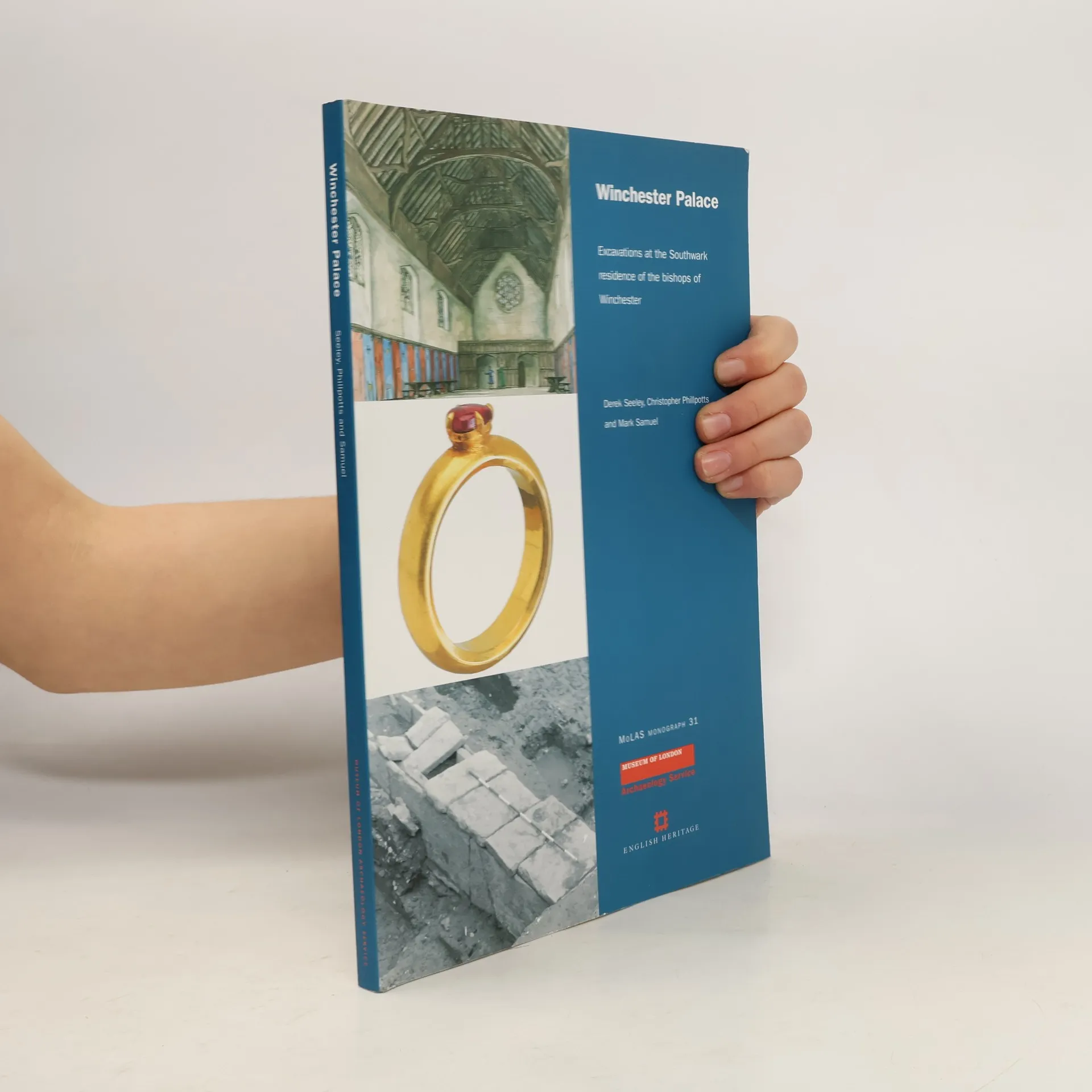
MOLAS Monograph - 31: Winchester Palace, Derek Seeley, Christopher Phillpotts, Mark Wycliffe Samuel
- Jazyk

- Rok vydania
- 2006
- Väzba
- (mäkká)
Doručenie
Platobné metódy
Nikto zatiaľ neohodnotil.
- Titul
- MOLAS Monograph - 31: Winchester Palace
- Podtitul
- Excavations at the Southwark Residence of the Bishops of Winchester
- Jazyk
- anglicky
- Vydavateľ
- MOLA (Museum of London Archaeology)
- Rok vydania
- 2006
- Väzba
- mäkká
- Počet strán
- 192
- ISBN10
- 1901992659
- ISBN13
- 9781901992656
- Série
- Štítky
- Historické téma, Európa, Anglicko, Veľká Británia, Stredovek, Archeológia, Inšpirácia, Londýn
- Anotácia
- Archaeological rescue excavations in Southwark from 1983 to 1990 revealed parts of the medieval bishops of Winchester's London house, supported by detailed documentary evidence. The property evolved into a palatial residence by the mid-12th century, featuring an inner and outer courtyard enclosed by a boundary wall. The 14th-century palace included a great hall, service rooms, and kitchens in the north range, with accommodations for household staff around the inner courtyard. The bishop's private quarters, chapel, and garden were also situated here. A passage beneath the hall connected the inner courtyard to the wharves and river, while storerooms, workshops, and stables lined the east boundary, complemented by gardens in the west half. A parliamentary survey from 1647 outlines the palace's layout, illustrated by Hollar in a sketch around 1644. The bishops retained ownership until the 1640s, regaining it post-Civil War, but the site became occupied by various tenants. By 1720, it was described as "disused and very ruinous." The medieval palace eventually transformed into tenements and small industrial units, with large warehouses built in the 19th century. A fire in 1814 exposed the medieval masonry of the hall, and the hall's west gable wall with its rose window remains a notable landmark today.