


Parametre
- 268 stránok
- 10 hodin čítania
Viac o knihe
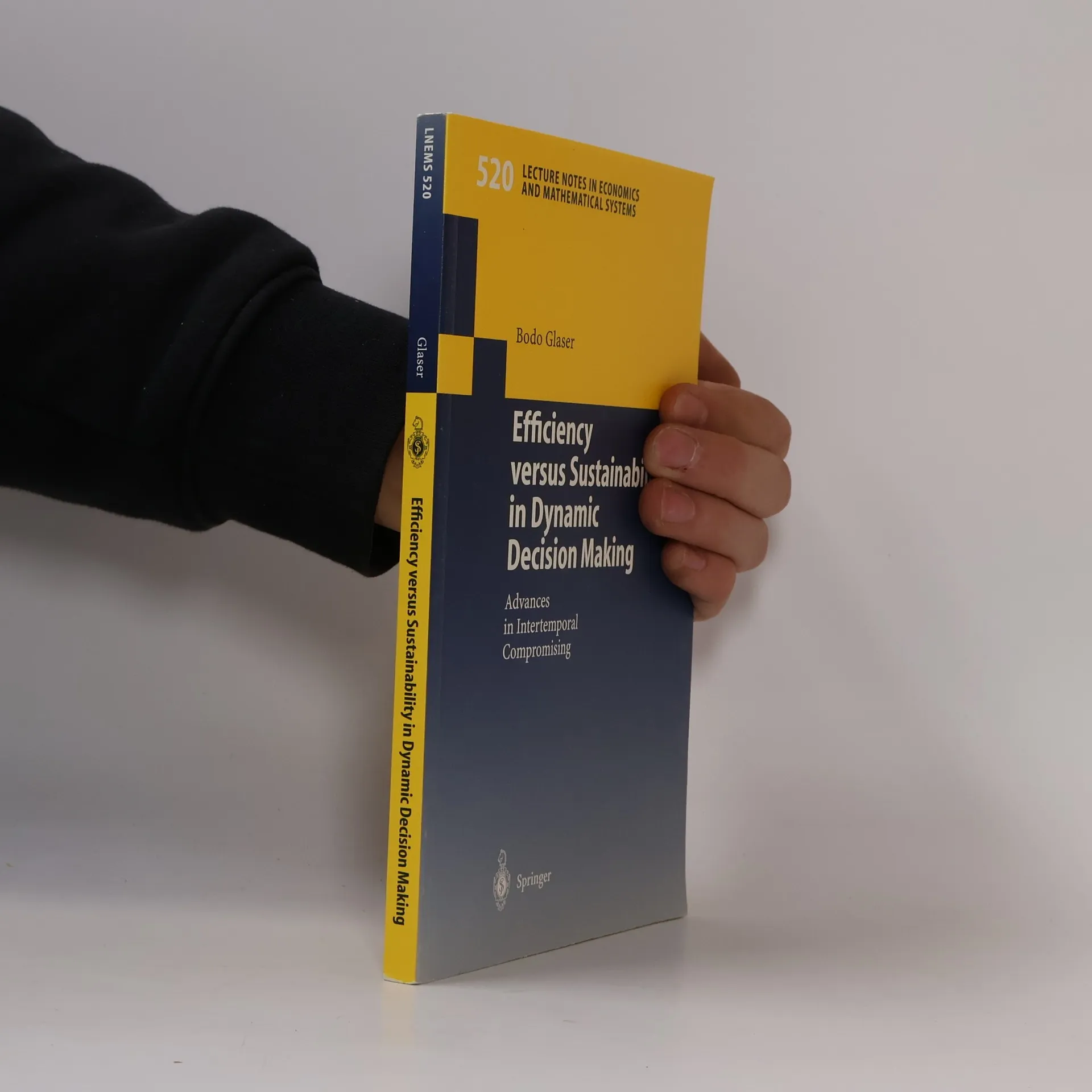
Over the past fifteen years, the concepts of efficiency and sustainability have significantly shaped discussions on resource allocation, particularly in relation to growth and environmental economics. This treatise develops and contrasts these notions through the construct of a trajectorial objective, which advances the classical scalar objective. It becomes evident that efficiency, aimed at minimizing waste, and sustainability, focused on maintaining critical aspiration levels for survival, are not identical. However, they are not mutually exclusive; rather, they can be integrated to create long-term solutions that uphold essential aspiration levels. The study introduces dynamic decision models (DDM) with a single trajectorial objective, employing multi-criteria decision-making (MCDM) methodologies. Additionally, the method of distance maximization enhances MCDM, proving invaluable for DDMs, particularly when a utopian trajectory is absent or when sustainability is the primary objective. This exploration aims to provide a framework for achieving unimprovable solutions that effectively balance efficiency and sustainability in resource management.
Nákup knihy
Lecture Notes in Economics and Mathematical Systems - 520: Efficiency Versus Sustainability in Dynamic Decision Making, Bodo Glaser
- Jazyk

- Rok vydania
- 2002
- Väzba
- (mäkká)
Nikto zatiaľ neohodnotil.
- Titul
- Lecture Notes in Economics and Mathematical Systems - 520: Efficiency Versus Sustainability in Dynamic Decision Making
- Jazyk
- anglicky
- Autori
- Bodo Glaser
- Vydavateľ
- Springer
- Rok vydania
- 2002
- Väzba
- mäkká
- Počet strán
- 268
- ISBN10
- 3540439064
- ISBN13
- 9783540439066
- Série
- Kategórie
- Štítky
- Byznys, Filozofická tematika, Medicína, Vedecké teórie, Udržateľnosť, Vývoj, Hospodárska politika, Rozhodovanie
- Anotácia
- Over the past fifteen years, the concepts of efficiency and sustainability have significantly shaped discussions on resource allocation, particularly in relation to growth and environmental economics. This treatise develops and contrasts these notions through the construct of a trajectorial objective, which advances the classical scalar objective. It becomes evident that efficiency, aimed at minimizing waste, and sustainability, focused on maintaining critical aspiration levels for survival, are not identical. However, they are not mutually exclusive; rather, they can be integrated to create long-term solutions that uphold essential aspiration levels. The study introduces dynamic decision models (DDM) with a single trajectorial objective, employing multi-criteria decision-making (MCDM) methodologies. Additionally, the method of distance maximization enhances MCDM, proving invaluable for DDMs, particularly when a utopian trajectory is absent or when sustainability is the primary objective. This exploration aims to provide a framework for achieving unimprovable solutions that effectively balance efficiency and sustainability in resource management.