



Parametre
- 288 stránok
- 11 hodin čítania
Viac o knihe
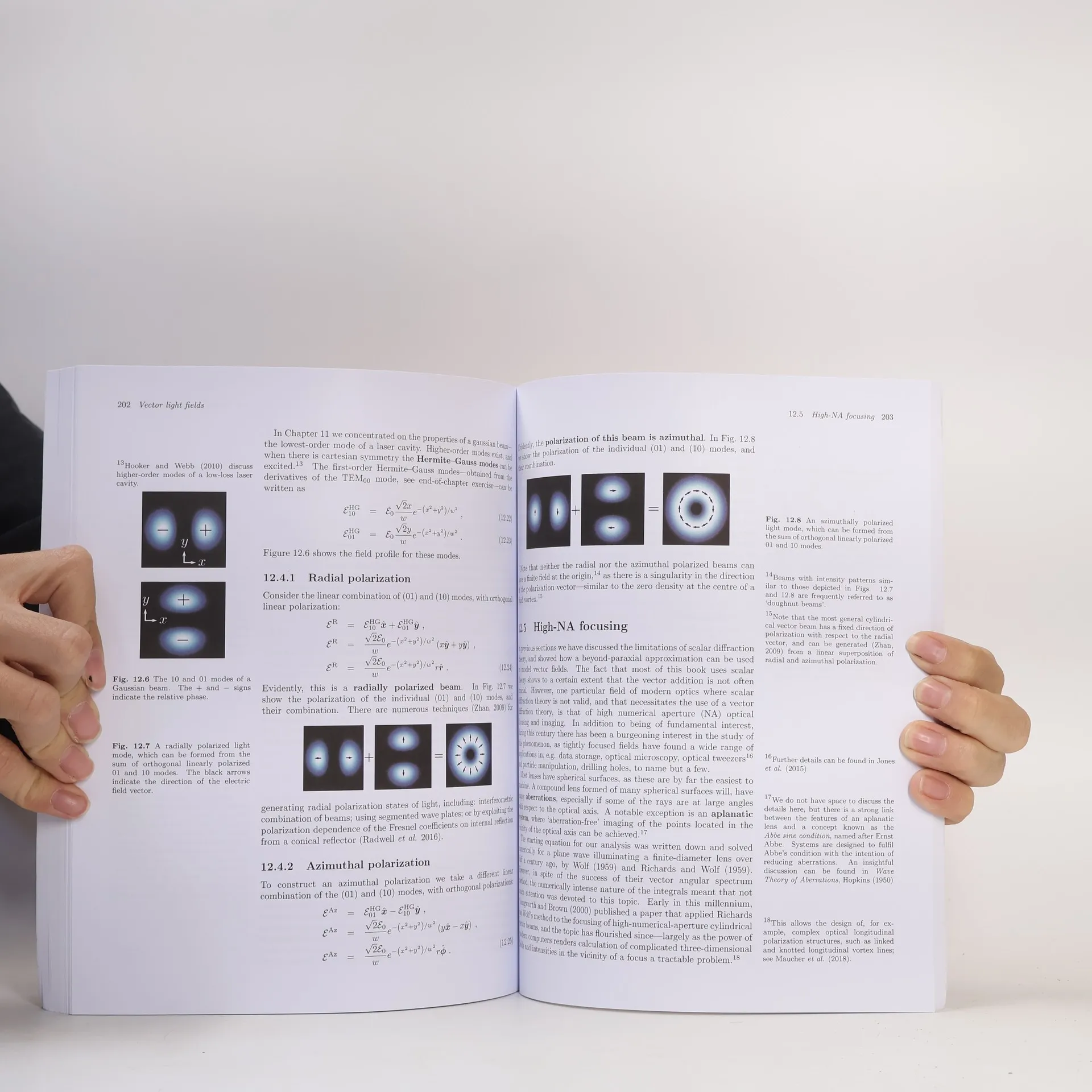
This textbook on optics provides an introduction to key concepts of wave optics and light propagation. It uniquely makes extensive use of Fourier methods and the angular-spectrum approach, especially to provide a unified approach to Fraunhofer and Fresnel diffraction. A recurring theme is that simple building blocks such as plane and spherical waves can be summed to construct useful solutions. The text pays particular attention to analysing topics in contemporary optics such as propagation, dispersion, laser beams and wave guides, apodisation, tightly-focused vector fields, unconventional polarization states, and light-matter interactions. Throughout the text, the principles are applied through worked examples, and the book is copiously illustrated with more than 240 figures. The 200 end-of-chapter exercises offer further opportunities for testing the reader's understanding.
Nákup knihy
Optics f2f, Edwin C. Tubb, Ifan G. Hughes
- Jazyk

- Rok vydania
- 2019
- Väzba
- (mäkká)
Nikto zatiaľ neohodnotil.
- Titul
- Optics f2f
- Podtitul
- From Fourier to Fresnel
- Jazyk
- anglicky
- Autori
- Edwin C. Tubb, Ifan G. Hughes
- Vydavateľ
- Oxford University Press
- Rok vydania
- 2019
- Väzba
- mäkká
- Počet strán
- 288
- ISBN10
- 0198786794
- ISBN13
- 9780198786795
- Série
- Kategórie
- Štítky
- Učebnice fyziky, Optika
- Anotácia
- This textbook on optics provides an introduction to key concepts of wave optics and light propagation. It uniquely makes extensive use of Fourier methods and the angular-spectrum approach, especially to provide a unified approach to Fraunhofer and Fresnel diffraction. A recurring theme is that simple building blocks such as plane and spherical waves can be summed to construct useful solutions. The text pays particular attention to analysing topics in contemporary optics such as propagation, dispersion, laser beams and wave guides, apodisation, tightly-focused vector fields, unconventional polarization states, and light-matter interactions. Throughout the text, the principles are applied through worked examples, and the book is copiously illustrated with more than 240 figures. The 200 end-of-chapter exercises offer further opportunities for testing the reader's understanding.