



Viac o knihe
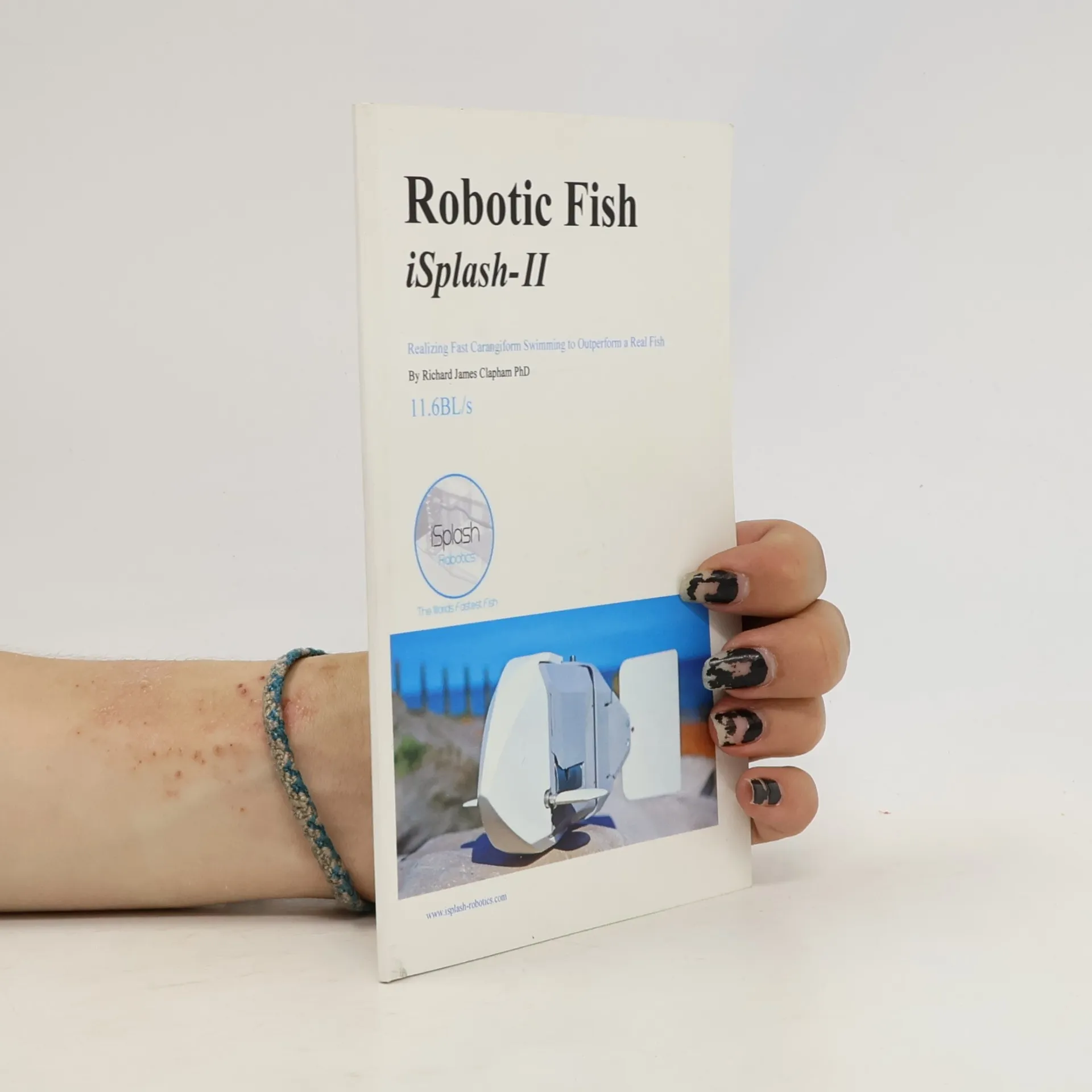
Abstract—This paper introduces a new robotic fish, iSplash-II, capable of outperforming real carangiform fish in terms of average maximum velocity (measured in body lengths/ second) and endurance, the duration that top speed is maintained. A new fabrication technique and mechanical drive system were developed, effectively transmitting large forces at high frequencies to obtain high-speed propulsion. The lateral and thrust forces were optimized around the center of mass, generating accurate kinematic displacements and greatly increasing the magnitude of added mass. The prototype, with a length of 32cm has significantly increased the linear swimming speed of robotic fish, achieving consistent untethered stabilized swimming speeds of 11.6BL/s (i.e. 3.7m/s), with a frequency of 20Hz. Robotic fish • Carangiform swimming • Mechanical drive system • Full-Body length.
Nákup knihy
Robotic Fish iSplash-II, Richard James Clapham
- Jazyk

- Rok vydania
- 2016
- Väzba
- (mäkká),
- Stav knihy
- Dobrá
- Cena
- 6,49 €
Nikto zatiaľ neohodnotil.
- Titul
- Robotic Fish iSplash-II
- Podtitul
- Realizing Fast Carangiform Swimming to Outperform a Real Fish
- Jazyk
- anglicky
- Autori
- Richard James Clapham
- Rok vydania
- 2016
- Väzba
- mäkká
- Počet strán
- 32
- ISBN10
- 1537270907
- ISBN13
- 9781537270906
- Série
- Štítky
- Veda, Technológia, Roboti, Robotika
- Anotácia
- Abstract—This paper introduces a new robotic fish, iSplash-II, capable of outperforming real carangiform fish in terms of average maximum velocity (measured in body lengths/ second) and endurance, the duration that top speed is maintained. A new fabrication technique and mechanical drive system were developed, effectively transmitting large forces at high frequencies to obtain high-speed propulsion. The lateral and thrust forces were optimized around the center of mass, generating accurate kinematic displacements and greatly increasing the magnitude of added mass. The prototype, with a length of 32cm has significantly increased the linear swimming speed of robotic fish, achieving consistent untethered stabilized swimming speeds of 11.6BL/s (i.e. 3.7m/s), with a frequency of 20Hz. Robotic fish • Carangiform swimming • Mechanical drive system • Full-Body length.