


Viac o knihe
2 chapter contains examples of intelligent agents, arranged according to their appli cation areas. Chapter 7 closes with a prospective view of the future development of intelligent agents. Everyone concerned with the Internet and the new possibilities of information and communication technology knows that nowadays there is no area that is devel oping faster. The authors are aware of the dynamics of this research area and its effects when they describe such a fast developing area in a slow, traditional me dium like a book. One thing is sure today: when the book appears on the market, new intelligent agents will already exist and some of the hypotheses made by this book will have been shown to be incorrect. Why, despite this, does it make sense to write a classical book on this subject? Is there an alternative? Experience shows that the majority of the people in business and public life who make decisions on the use of new technologies continue to prefer books and articles in periodicals rather than electronic sources such as the Internet. Or is there some other reason for the enormous success of Nicolas Negroponte's book Being Digital, which we thank for multimedia and many concepts of the digital and networked world, and even intelligent agents? Today, a book is still the only way to establish a new area.

Nákup knihy
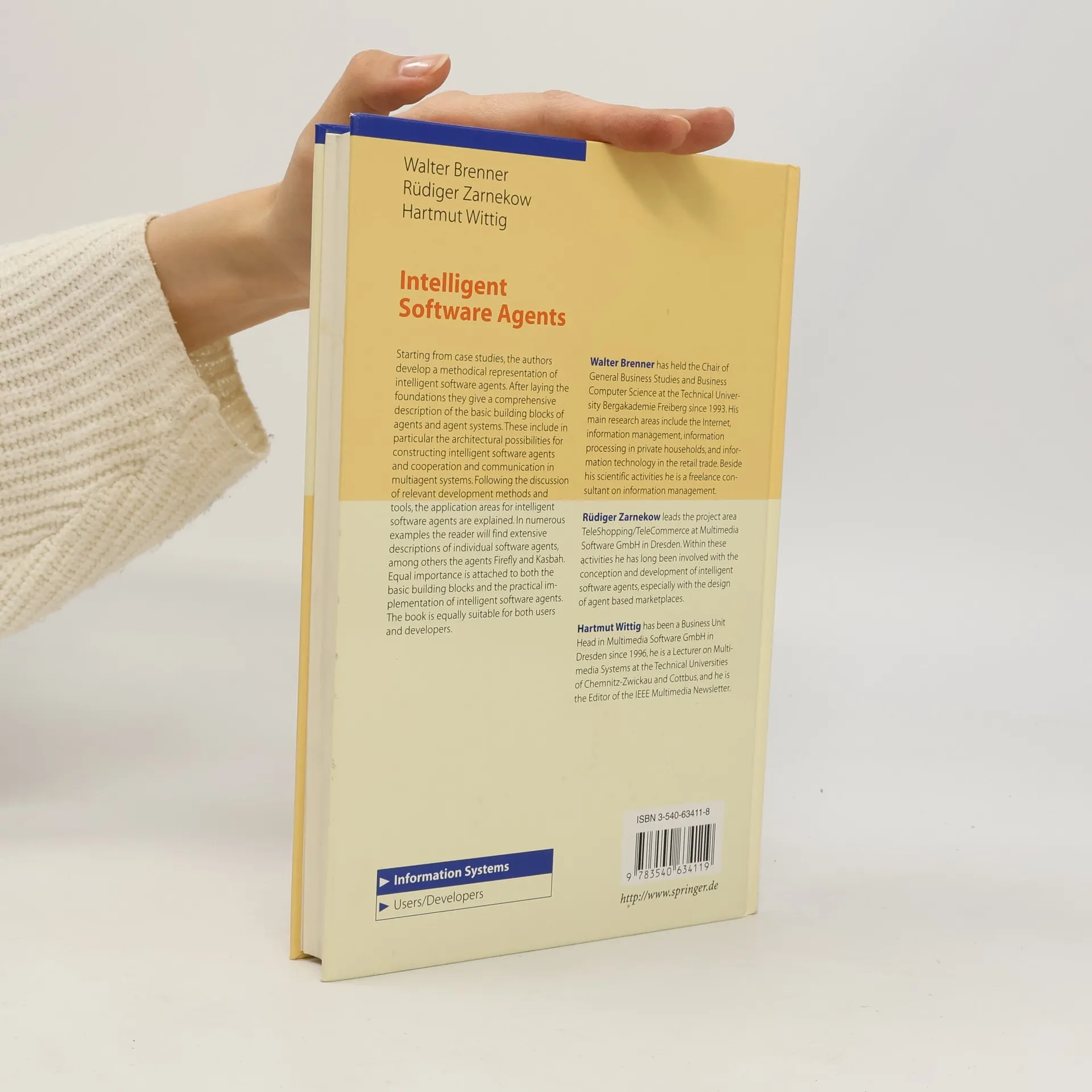
Intelligent Software Agents, Walter Brenner, Rüdiger Zarnekow, Hartmut Wittig
- Jazyk

- Rok vydania
- 1998
- Väzba
- (pevná)
Doručenie
Platobné metódy
Nikto zatiaľ neohodnotil.
- Titul
- Intelligent Software Agents
- Podtitul
- Foundations and Applications
- Jazyk
- anglicky
- Vydavateľ
- Springer
- Rok vydania
- 1998
- Väzba
- pevná
- Počet strán
- 326
- ISBN10
- 3540634118
- ISBN13
- 9783540634119
- Série
- Štítky
- Anotácia
- 2 chapter contains examples of intelligent agents, arranged according to their appli cation areas. Chapter 7 closes with a prospective view of the future development of intelligent agents. Everyone concerned with the Internet and the new possibilities of information and communication technology knows that nowadays there is no area that is devel oping faster. The authors are aware of the dynamics of this research area and its effects when they describe such a fast developing area in a slow, traditional me dium like a book. One thing is sure today: when the book appears on the market, new intelligent agents will already exist and some of the hypotheses made by this book will have been shown to be incorrect. Why, despite this, does it make sense to write a classical book on this subject? Is there an alternative? Experience shows that the majority of the people in business and public life who make decisions on the use of new technologies continue to prefer books and articles in periodicals rather than electronic sources such as the Internet. Or is there some other reason for the enormous success of Nicolas Negroponte's book Being Digital, which we thank for multimedia and many concepts of the digital and networked world, and even intelligent agents? Today, a book is still the only way to establish a new area.