

Bookbot

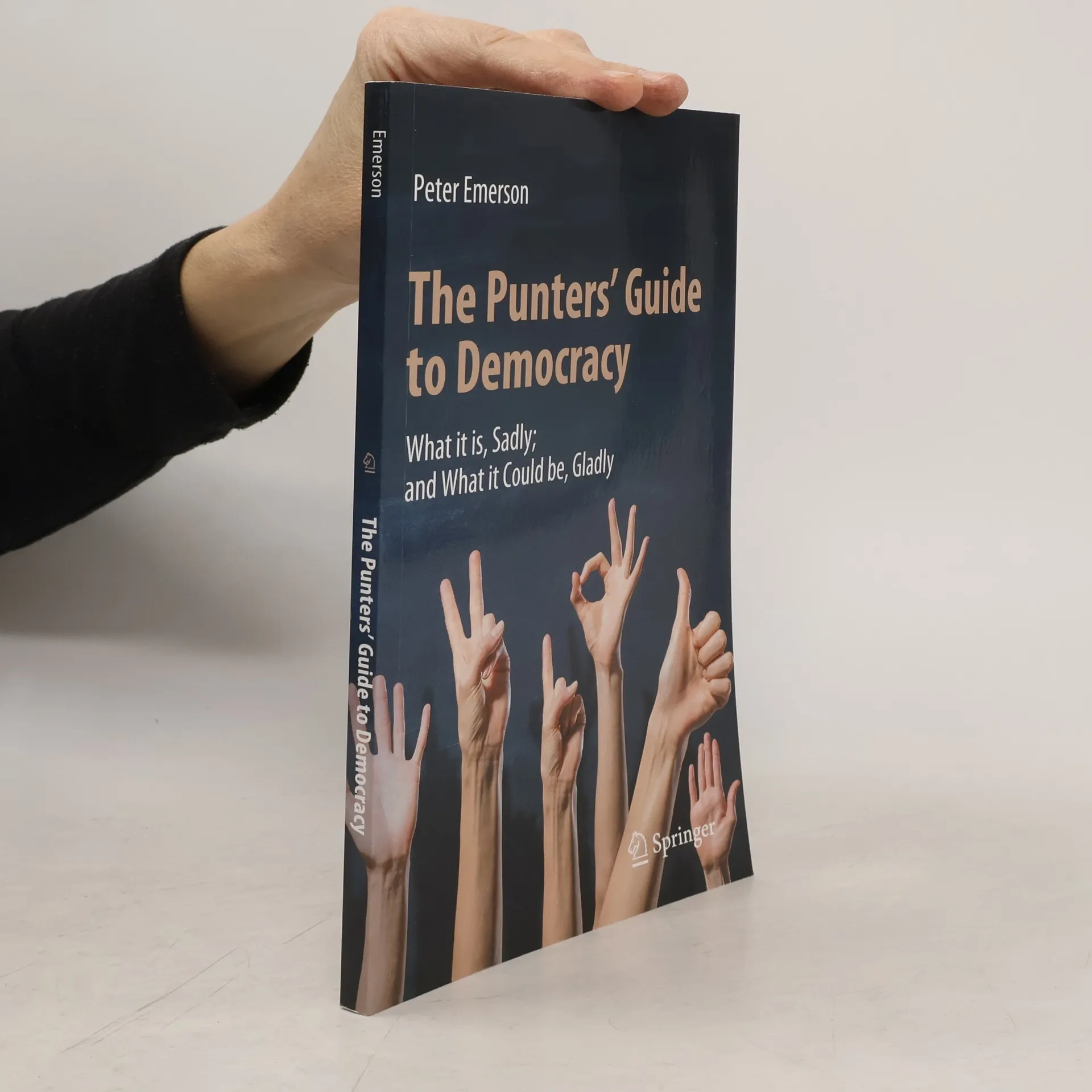
Peter Emerson

    The Punters' Guide to Democracy
    Air War Over North Vietnam
    Democratic Decision-making
    Majority Voting as a Catalyst of Populism
    From Majority Rule to Inclusive Politics
    North Vietnam's 1972 Easter Offensive
    • North Vietnam's 1972 Easter Offensive

      • 136 stránok
      • 5 hodin čítania

      By late 1971 Secretary General Le Duan had successfully persuaded the politburo that the coming year was to be a decisive year in compelling the Americans to end the war on Hanoi's terms by striking a crushing military blow against the Saigon government o číst celé

      North Vietnam's 1972 Easter Offensive
    • From Majority Rule to Inclusive Politics

      • 176 stránok
      • 7 hodin čítania

      This book discusses voting procedures in collective decision-making. Drawing on well-established election processes from all over the world, the author presents a voting procedure that allows for the speedy but fair election of a proportional, all-party coalition. The methodology - a matrix vote - is accurate, robust and ethno-color blind. In the vote, the counting procedure encourages all concerned to cross the gender as well as any party and/or sectarian divides. While in the resulting executive each party will be represented fairly and, at best, with the consensus of parliament, every minister will be the one most suited to his/her new portfolio. By using preferential voting and thus achieving consensus, the matrix vote will be fundamental to the resolution of conflicts. The matrix vote can also be used when: • two or more parliamentary parties elect a coalition government • one parliamentary party elects a government or shadow cabinet, or organizations in civil society elect their governing boards or executive committees • any group chooses a fixed number of individuals to form a team in which each member carries out a different function

      From Majority Rule to Inclusive Politics
    • Majority Voting as a Catalyst of Populism

      Preferential Decision-making for an Inclusive Democracy

      • 268 stránok
      • 10 hodin čítania

      Focusing on the limitations of binary majority rule, the book critiques how two-option ballots often fail to represent the public's true will, leading to populism and conflict in various regions, including Europe and Asia. Drawing on the author's experiences, it highlights the divisive nature of simple majority voting, particularly in war zones and unstable democracies. To promote democratic stability, it advocates for an all-party power-sharing model and explores alternative voting methods through case studies from diverse geographical contexts.

      Majority Voting as a Catalyst of Populism
    • Democratic Decision-making

      Consensus Voting for Civic Society and Parliaments

      • 132 stránok
      • 5 hodin čítania

      Exploring the dynamics of collective decision-making, this book analyzes various voting procedures from local councils to global organizations. It critiques binary voting for its divisiveness and inaccuracies, advocating for a preferential points system that promotes inclusivity and democracy. Essential for those interested in fair decision-making, the text also compares common electoral systems, offering insights into more effective methodologies that benefit all participants.

      Democratic Decision-making
    • Operation Rolling Thunder was a disastrous and wasteful attempt in terms of men and material by the Johnson administration to micromanage an air campaign to achieve specific diplomatic goals, but in the end achieved neither military nor political victory. číst celé

      Air War Over North Vietnam
    • The Punters' Guide to Democracy

      What it is, Sadly; and What it Could be, Gladly

      This book discusses multiple ways of voting in a democratic system and explains the basis of more consensual politics. Without delving into too much technical argument or too many mathematical examples, it aims to show that binary decision-making is blunt, primitive, divisive, and sometimes inaccurate; prove that other methodologies are more accurate and, therefore, more democratic; highlight more inclusive and effective voting procedures; discuss electoral reforms for national parliaments and international forums like the UN Security Council and COP26/27. The book is written not just for academia, or for the politicians and journalists, or for other specialists; it is for the general public: for students still at school, for voters in society at large, and for activists in umpteen NGOs

      The Punters' Guide to Democracy