


Bookbot

Gilbert Simondon

    Imagination und Invention
    Überlegungen zur Techno-Ästhetik
    Du mode d'existence des objets techniques
    Imagination and Invention
    On the Mode of Existence of Technical Objects
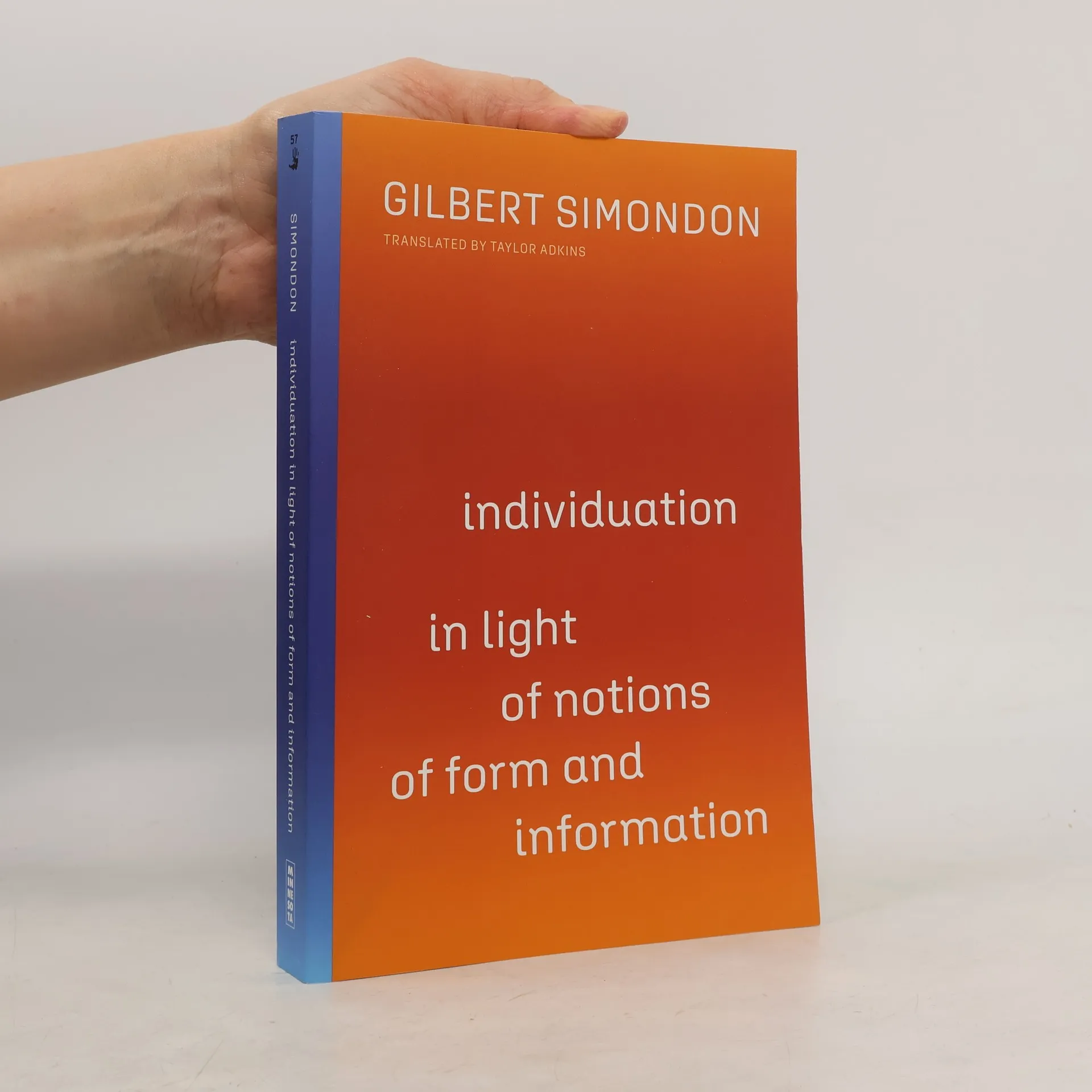
    Individuation in Light of Notions of Form and Information
    • A long-awaited translation on the philosophical relation between technology, the individual, and milieu of the living From Democritus's atomism to Heisenberg's uncertainty principle, from Aristotle's reflections on the individual to Husserl's call for a focused return to things, from the philosophical advent of the Cartesian ego and the Leibnizian monad to Heidegger's notion of Dasein, the question concerning the constitution of the individual has continued to loom large over the preoccupations of philosophers and scholars of scientific disciplines for thousands of years. Through conceptions in modern scientific areas of research such as thermodynamics, the fabrication of technical objects, gestalt theory, cybernetics, and the dynamic formation at work in the creation of crystals, Gilbert Simondon's unique multifaceted philosophical and scholarly research will eventually lead to an astounding reevaluation and questioning of the historical methods for posing the very question and notion of the individual. More than fifty years after its original publication in French, this groundbreaking work of philosophical theory is now available in its first complete English language translation.

      Individuation in Light of Notions of Form and Information
    • For Gilbert Simondon, the human/machine distinction is perhaps not a simple dichotomy and there is much to learn from technical objects. He takes up the task of a true thinker who sees the potential for humanity to uncover life-affirming modes of technical objects whereby we can discover potentiality for novel, healthful, and dis-alienating rapports with them.

      On the Mode of Existence of Technical Objects
    • A radical rethinking of the theory and the experience of mental imagesHere, in English translation for the first time, is Gilbert Simondon’s fundamental reconception of the mental image and the theory of imagination and invention. Drawing on a vast range of mid-twentieth-century theoretical resources—from experimental psychology, cybernetics, and ethology to the phenomenological reflections of Sartre and Merleau-Ponty— Imagination and Invention provides a comprehensive account of the mental image and adds a vital new dimension to the theory of psychical individuation in Simondon’s earlier, highly influential work. Simondon traces the development of the mental image through four phases: first a bundle of motor anticipations, the image becomes a cognitive system that mediates the organism’s relation to its milieu, then a symbolic and abstract integration of motor and affective experience to, finally, invention, a solution to a problem of life that requires the externalization of the mental image and the creation of a technical object. An image cannot be understood from the perspective of one phase alone, he argues, but only within the trajectory of its progressive metamorphosis.

      Imagination and Invention
    • Quatrième de couverture:L'ouvrage de Gilbert Simondon est célèbre à un double titre. C'est l'une des premières et des plus fortes tentatives pour réintroduire l'objet technique dans la culture, faire cesser son aliénation purement ustensile, découvrir les valeurs d'humanité qu'il contient et que la philosophie a trop longtemps méconnues au nom de la relation de propriété ou d'usage.C'est ensuite une élucidation originale de l'essence des objets techniques. Simondon la décrit comme une genèse spécifique qui prend la forme d'un processus dit de « concrétisation », distinct aussi bien des perfectionnements empiriques que de toute déduction à partir de principes théoriques préalables. Cette conception s'élargit sur des perspectives éthiques, religieuses et esthétiques qui découvrent la portée philosophique de l'entreprise.

      Du mode d'existence des objets techniques
    • Überlegungen zur Techno-Ästhetik

      Mit einem Kommentar von Charlotte Bolwin, Moritz Riemann und Shirin Weigelt

      • 116 stránok
      • 5 hodin čítania

      Gilbert Simondons Überlegungen zur Techno-Ästhetik, die aus einem unvollendeten Brief an Jacques Derrida stammen, erweitern die Diskussion über das Mensch-Maschine-Verhältnis um ästhetische Aspekte. Der erstmals auf Deutsch veröffentlichte Text wird durch einen ausführlichen Kommentar kontextualisiert und beleuchtet das Techno-Ästhetische als Teil einer relationalen Ontologie. Simondons Betrachtungen zu Alltagsgegenständen und Infrastrukturen verdeutlichen, wie Technik als sinnliches Ausdrucksgeschehen fungiert und die Verbindung zwischen Mensch, Natur und Kultur herstellt.

      Überlegungen zur Techno-Ästhetik
    • Ingenieure, Architekten, Schachspieler, Dichter und Revolutionäre verbindet eines: Ihre Praxis ist elementar auf Bilder angewiesen. Welche Rolle diese jedoch in der Herausbildung neuen Wissens spielen und worin sich die Findigkeit der Imagination äußert – diesen Fragen geht Gilbert Simondon in seinen wegweisenden Sorbonne-Vorlesungen aus den Jahren 1965/66 nach. Dabei belässt er es nicht bei einer Spurensuche nach der Bedeutung von Bildern für das menschliche Leben, vielmehr fahndet er nach der Verbindung von Bildern und Lebendigkeit überhaupt. So befassen sich die Vorlesungen neben der Logik wissenschaftlicher und künstlerischer Innovationen zunächst mit dem Einsatzort von inneren und äußeren Bildern in biologischen und psychologischen Entwicklungsprozessen. Mit einer Selbstverständlichkeit, die den Zeitgenossen oft suspekt war, stehen bei Simondon individualpsychologische, kulturtechnische und verhaltensbiologische Aspekte gleichberechtigt nebeneinander. Zu Recht als Wegbereiter eines postanthropozentrischen Denkens gehandelt, legt er hier eine Theorie der Bildzyklen vor, die für menschliche und nichtmenschliche Kollektive gleichermaßen gelten soll.

      Imagination und Invention