
Z Knihobotu sa stal Bookbot!
Bookbot

Catherine Fet

    Life of Jesus in European Art - for Kids
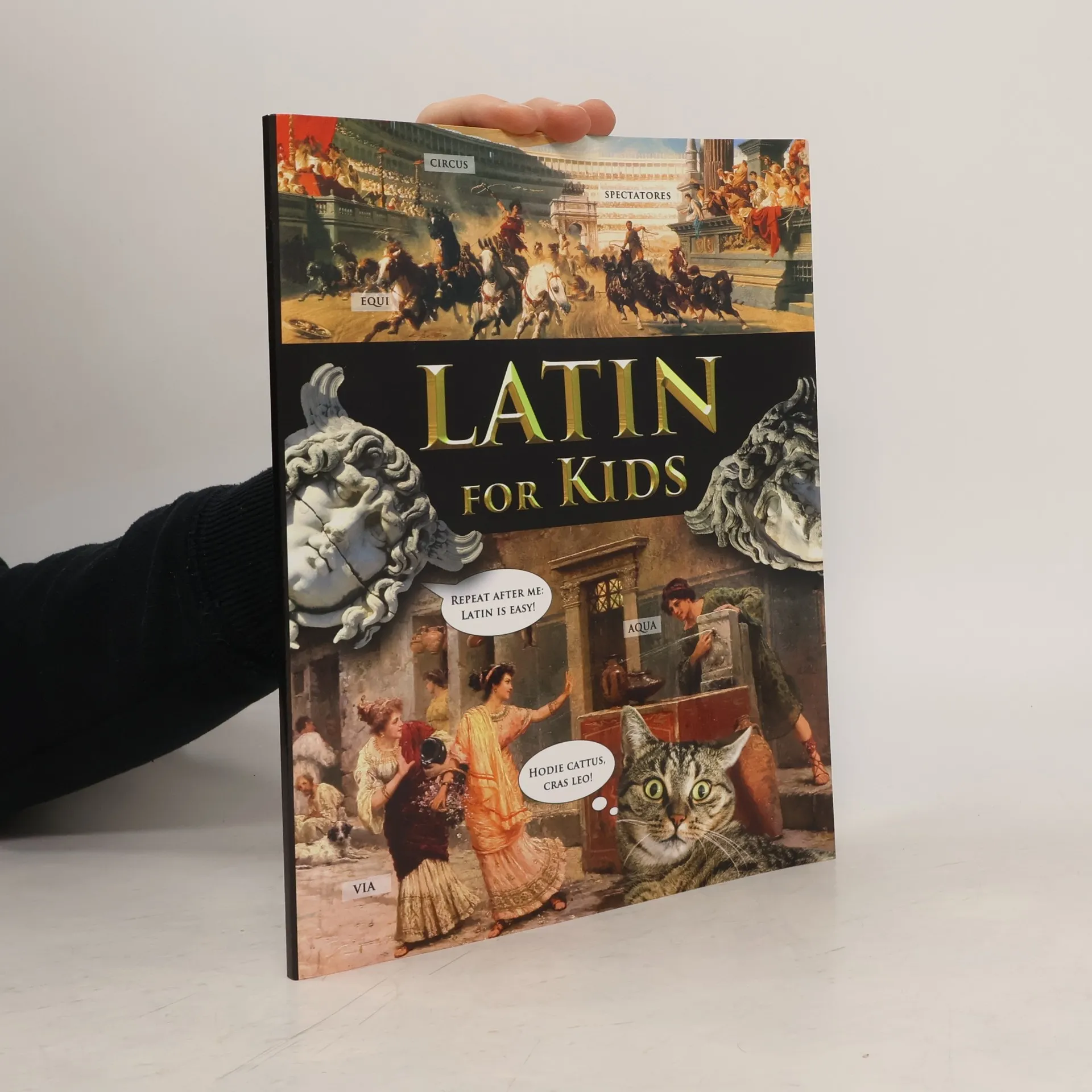
    Latin for Kids
    • Latin for Kids

      • 72 stránok
      • 3 hodiny čítania

      This book teaches Latin the traditional way - in a highly non-traditional presentation. Every page is bursting with color and overflowing with funny illustrations, silly humor, surprise captions, and recurring Latin-speaking animal characters and Roman statues. The book is for kids, but...- if you are a college student terrified of Latin, grab this book, and relax. You won't be lost in an endless desert of conjugation charts and exclusions from exclusions... The dialogues will not feature boring Roman farmers, soldiers, or sailors – yawn! I'll keep you smiling at a lazy Roman school kid, his nasty teacher, a unicorn, a princess, and some barbarians about to sack Rome - our kind of environment! No pain figuring out long and short syllables – I mark stress in all more-than-two-syllable words, so give it a try!- if you are a grownup curious - for whatever reason - about Latin, grab the book! It's your soft landing - be it in Ancient Rome, or at a Latin mass! Worth trying.Full I have a stake in this game. I wrote this book to teach Latin to my 9-year-old son. I don't think he'll grow up a scholar like me, but here are the reasons why I want my kid, you, and your kids to know at least some Up to 90% of multi-syllable words in English are of Latin origin. Latin will make our kids comfortable with long/important/scary words. They won't bat an eyelash when they hear 'ostentatious' or 'edifice.' Once they have learned the Latin verb 'scire' - 'to know,' they won't make mistakes spelling 'science'!2. French, Italian, Spanish, Portuguese – these are poor relatives of Latin. If you have some basic knowledge of Latin, all Romance languages are a piece of cake. I've never learned a word of Spanish, but I understand it quite well. Hurrah for ancient Romans!In this book I offer quite a bit of spoken Latin - for play. Kids may enjoy playing 'Ancient Rome,' or mess with a language nobody around them understands. But our real goal is not Latin conversation. The real goal is fully mobilizing our passive knowledge of the ability to recognize and understand Latin roots, prefixes and suffixes in English words of Latin origin;- the ability to competently use terms of Latin origin in fields such as law, politics, medicine, science, and more;- the ability to understand and correctly use Latin sayings, historical quotes, and mottos - as elements of European cultural to Latin Grammar- noun and adjective Nominative, Genitive, Dative, Accusative, Ablative and Vocative cases - singular and plural in all five declensions; - adjectives - comparative and superlative degrees;- pronouns - most widely used forms;- use of cases with common prepositions (in, a/ab, ad, e/ex, inter, cum, per, and more);- verb conjugations in Indicative Present, Past Perfect, Past Imperfect, and Indicative Future;- Imperative Mood;- Past Participle;- Accusativus cum Infinitivo;- Instrumental Ablative Case;- conjugation of frequently used irregular verbs, such as esse, posse, velle, nolle, ire, and others.All grammatical explanations are richly illustrated with level-appropriate Latin sayings and proverbs and accompanied with conversational exercises.Vocabulary development- Whenever we learn new Latin words, I list modern English words related to our Latin vocabulary.- Proverbia et In every lesson I suggest 2-3 Latin expressions or phrases – from either Classical or Church Latin - for memorization.- The book offers nine collections of terms (with Latin etymology) from Law, Science, Medicine, Government and Civics, and more.Practice, or homework, sections include translation from English to Latin and 2-3 engaging kid-friendly texts for Familia Romana, Schola, famous mottos and sayings, and Church Latin texts, such as the Lord's Prayer, Glory Be, Adeste Fideles, and a few bits from the Latin Mass.

      Latin for Kids
    • Life of Jesus in European Art - for Kids

      • 70 stránok
      • 3 hodiny čítania

      This book closely follows the gospel stories of Jesus' life, death, and resurrection from the Annunciation through Pentecost. It has the dual goal of introducing young readers to the gospel narratives and teaching them to appreciate and interpret works of art portraying gospel-based stories and allegories. The heritage of Christian art is a vital part of the history of Europe and the Western world. Whether our families are Christian, non-Christian, or secular, our cultural education is incomplete without a knowledge and appreciation of art inspired by Christian concepts and symbolism. Each mini-chapter of this book consists of two 1. Event Narration Each story from Jesus' life is narrated, directly quoting newer, easy-to-read gospel translations and partially summarizing events to keep the narration compact. The narration carefully avoids any "preachy" or interpretative elements suggesting this or that theological or denominational angle. 2. Illustrations and Art Commentary Each event is illustrated with one or two paintings - great works of European art from the Middle Ages through the 19th century. The Art Commentary section - draws the attention of a young reader to the stylistic features of each painting, - teaches them to spot Christian symbolism and interpret the emotions of characters, - presents glimpses of art history and teaches the reader to recognize historical art styles, such as medieval Gothic art, Renaissance, Mannerist, Baroque, Academic, Pre-Raphaelite, and realistic art styles. The reading level of this book is about age 9 and up. Whenever the narration includes any theological terms (such as Annunciation, Ascension, Messiah) or art terms (such as foreground, perspective, composition) I provide a definition.

      Life of Jesus in European Art - for Kids