

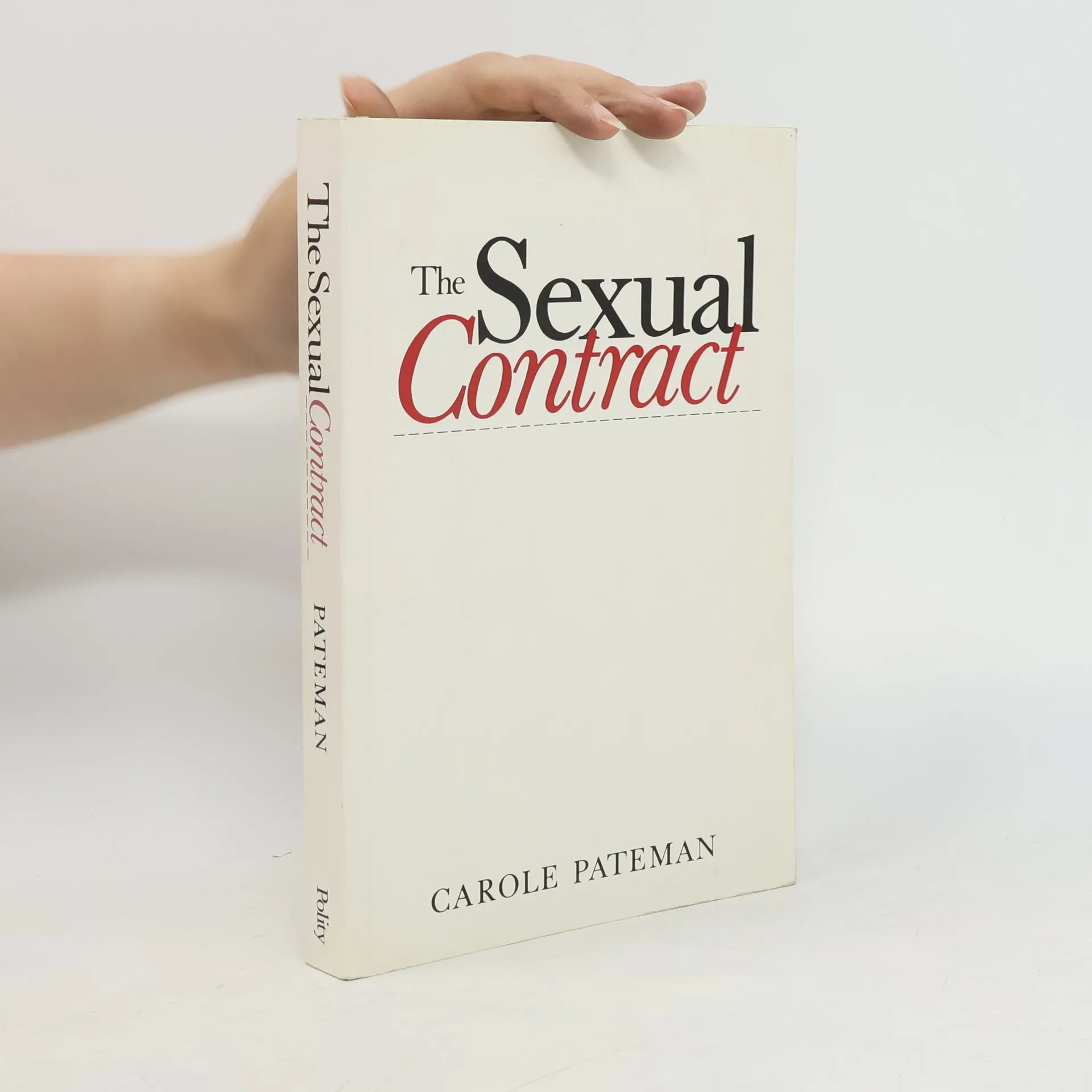


Parametre
- 280 stránok
- 10 hodin čítania
Viac o knihe
In this original work of political philosophy, a leading feminist theorist challenges contemporary societal norms by questioning the traditional interpretation of the social contract as articulated by Locke, Hobbes, and Rousseau, and later by the Founding Fathers in the U.S. The author reveals that the narrative of the original contract, which underpins modern patriarchy, is incomplete. The sexual contract is often overlooked, leading to a disregard for men's patriarchal rights over women. The exclusion of women from the original contract raises significant issues when they are later included in the new contractual order. A key focus is on those who attempt to adapt contractarian theory for progressive purposes, arguing that this is fundamentally flawed. Feminists seeking a more equitable contract between equal partners or without coercion are misled, as the author asserts that "universal freedom is always a hypothesis, a story, a political fiction." The book also critiques mainstream political theorists and critics of contract theory. By examining contracts in everyday life—such as marriage, employment, prostitution, and surrogacy—the author employs a feminist lens to illuminate the contradictions surrounding women and contracts, ultimately addressing deeper political issues of freedom and subordination.


Nákup knihy
Sociology of Health and Illness Monographs: The Sexual Contract, Carole Pateman
- Jazyk

- Rok vydania
- 1988
- Väzba
- (mäkká)
Tu nám chýba tvoja recenzia
- Titul
- Sociology of Health and Illness Monographs: The Sexual Contract
- Jazyk
- anglicky
- Autori
- Carole Pateman
- Vydavateľ
- Polity Press
- Rok vydania
- 1988
- Väzba
- mäkká
- Počet strán
- 280
- ISBN10
- 0745604323
- ISBN13
- 9780745604329
- Série
- Kategórie
- Hodnotenie
- 4 z 5
- Anotácia
- In this original work of political philosophy, a leading feminist theorist challenges contemporary societal norms by questioning the traditional interpretation of the social contract as articulated by Locke, Hobbes, and Rousseau, and later by the Founding Fathers in the U.S. The author reveals that the narrative of the original contract, which underpins modern patriarchy, is incomplete. The sexual contract is often overlooked, leading to a disregard for men's patriarchal rights over women. The exclusion of women from the original contract raises significant issues when they are later included in the new contractual order. A key focus is on those who attempt to adapt contractarian theory for progressive purposes, arguing that this is fundamentally flawed. Feminists seeking a more equitable contract between equal partners or without coercion are misled, as the author asserts that "universal freedom is always a hypothesis, a story, a political fiction." The book also critiques mainstream political theorists and critics of contract theory. By examining contracts in everyday life—such as marriage, employment, prostitution, and surrogacy—the author employs a feminist lens to illuminate the contradictions surrounding women and contracts, ultimately addressing deeper political issues of freedom and subordination.