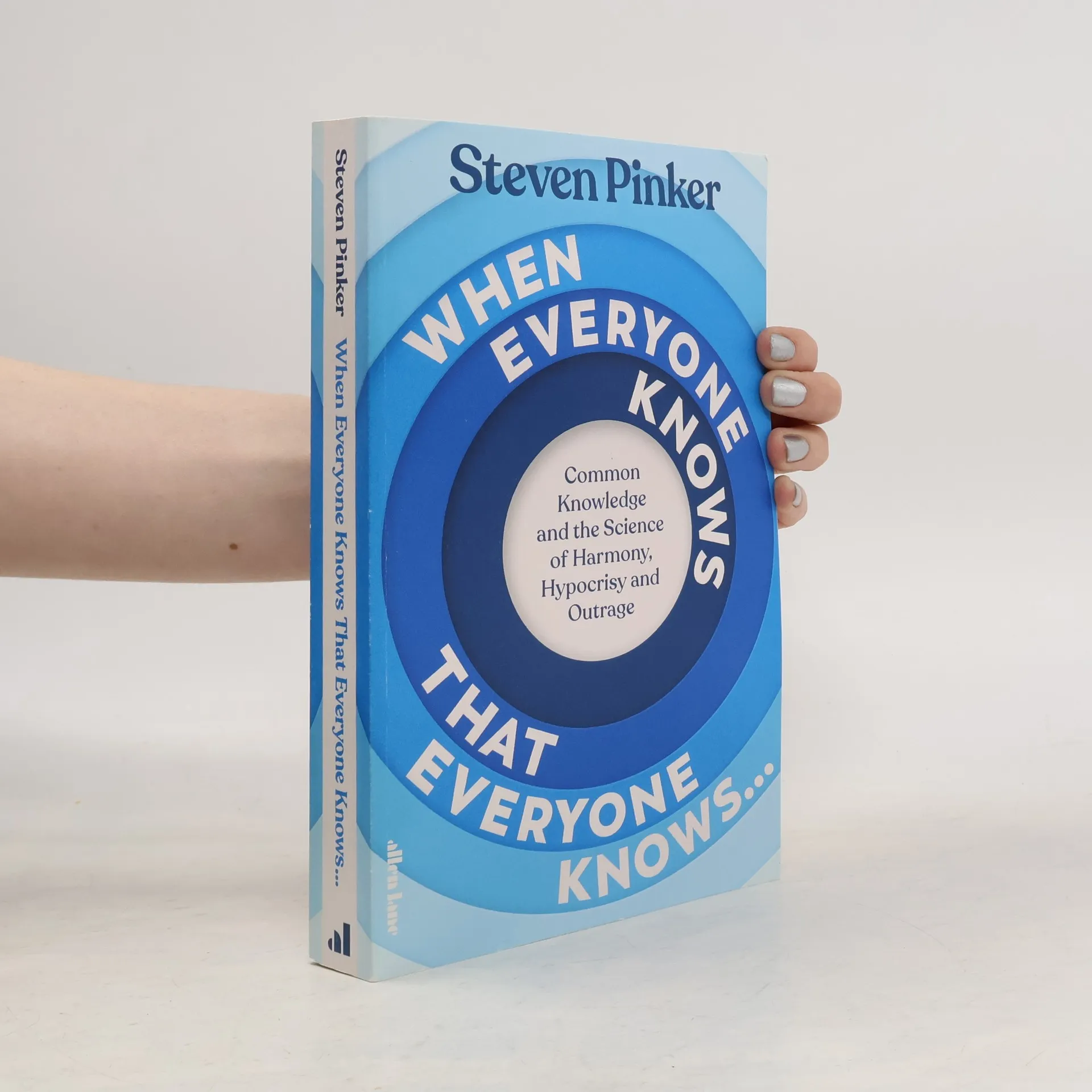
When Everyone Knows That Everyone Knows...
Common Knowledge and the Science of Harmony, Hypocrisy and Outrage
- 384 stránok
- 14 hodin čítania


Steven Pinker je popredný kanadsko-americký experimentálny psychológ a kognitívny vedec, známy svojím širokým skúmaním ľudskej prirodzenosti a jej vzťahu k jazyku, histórii, morálke a politike. Jeho práca sa zameriava na jazyk a kogníciu, pričom obratne prepláva komplexnými témami s jasnosťou a prenikavosťou. Pinkerovo odvážne skúmanie spochybňuje bežné predstavy a vyzýva čitateľov, aby prehodnotili svoje chápanie ľudského správania a pokroku. Prostredníctvom svojho písania sa snaží osvetliť mechanizmy mysle a dôsledky poznania pre spoločnosť.




Common Knowledge and the Science of Harmony, Hypocrisy and Outrage
Gemeinsames Wissen und sein verblüffender Einfluss auf Geld, Macht und das tägliche Leben
Wie Gemeinsames Wissen unsere Gesellschaft bildet – die erste umfassende Theorie Von der Börse über internationale Beziehungen bis hin zu privaten Verabredungen: Tagtäglich treffen wir Annahmen darüber, was andere Menschen wissen und denken, und richten unser Handeln danach aus – oft, ohne uns dessen bewusst zu sein. Steven Pinker befasst sich in seinem neuen Buch damit, wie wir den Wissensstand anderer Menschen einschätzen. Anhand von zahlreichen Beispielen aus der Spieltheorie, der Geschichte und unserem Alltag zeigt er so klar wie unterhaltsam, dass unsere alltäglichen Interaktionen auf komplexesten Überlegungen beruhen – und warum diese Tatsache unser Zusammenleben entscheidend prägt.
Prečo je ľudstvo po celé stáročia napriek ohromnému technickému a inteligenčnému pokroku také náchylné veriť falošným poplašným správam, nezmyselným konšpiráciám a dokonca aj samozvaným liečiteľom – šarlatánom? Racionálne premýšľanie je ako šípka hodená správnym smerom a Pinkerov triezvy, humorný pohľad pomôže objasniť a posilniť naše vedomie – praktické myslenie.
Ak vás zaujala Roslingova publikácia Moc faktov, Steven Pinker ho vo svojich záveroch len podporí a doplní. Jeho kniha je plná vášnivého odporu voči pesimizmu a nesúhlasu so zaužívaným pocitom, že moderný svet je odsúdený na zánik. Pinker dôkladne preštudoval vývoj v minulých storočiach a dospel k jednoznačnému záveru, že život sa neustále zlepšuje. Dnes žijeme dlhšie, zdravšie, bezpečnejšie, šťastnejšie, blahobytnejšie a v mieri. Táto kniha je určená pre ľudí, ktorí majú radi argumenty a dáta. So Stevenom Pinkerom by ste sa fakt nechceli pohádať! Ak si myslíte, že sa svet rúti do pekla, táto kniha vás rozhodne vyvedie z omylu. Zistíte, že na tom vôbec nie sme tak zle, ako si myslíme a ako to často prezentujú senzáciechtivé médiá. Ak sa však k moci dostanú populisti a vydržia tam dosť dlho, všetko, čo sme zatiaľ ako ľudstvo dosiahli, môže byť ohrozené. Veda, rozum, humanizmus a pokrok sú základom ľudského blahobytu a treba za ne stoj čo stoj bojovať.
Het belangrijkste wetenschappelijke nieuws volgens 193 'briljante geesten'
Bijna dagelijks worden we geconfronteerd met nieuwe inzichten en weetjes, variërend van wereldbelang tot drijfzand. Of het nu gaat om dieetvoorschriften, experimentele medicijnen, technologische doorbraken of klimaatvoorspellingen, het is voor leken vaak onmogelijk om waardevolle informatie te onderscheiden van onzin. Wat zijn de ontdekkingen die écht invloed hebben op onze toekomst? John Brockman, oprichter van edge.org, vroeg invloedrijke wetenschappers en denkers naar het meest interessante recente wetenschappelijke nieuws. Steven Pinker wijst op de kwantificering van menselijke vooruitgang als een opmerkelijke ontwikkeling. Chris Anderson is onder de indruk van het sociale experiment dat internet vertegenwoordigt en de opkomst van een wereldwijd collectief bewustzijn. Max Tegmark waarschuwt dat technologische en wetenschappelijke vooruitgang de leercurve van onze wijsheid overstijgt, wat zorgwekkend is, vooral bij gevoelige onderwerpen zoals kernwapens. Peter Gabriel benadrukt hoe hersenwetenschap de grens tussen fantasie en werkelijkheid vervaagt. Daarnaast delen ook John C. Mather, Bill Joy, Michael Shermer, Matt Ridley, George Church en anderen hun inzichten, wat een breed scala aan perspectieven biedt op de huidige wetenschappelijke ontwikkelingen.
"Progress. It is one of the animating concepts of the modern era. From the Enlightenment onwards, the West has had an enduring belief that through the evolution of institutions, innovations, and ideas, the human condition is improving. This process is supposedly accelerating as new technologies, individual freedoms, and the spread of global norms empower individuals and societies around the world. But is progress inevitable? Its critics argue that human civilization has become different, not better, over the last two and a half centuries. What is seen as a breakthrough or innovation in one period becomes a setback or limitation in another. In short, progress is an ideology not a fact; a way of thinking about the world as opposed to a description of reality. In the seventeenth semi-annual Munk Debates, which was held in Toronto on November 6, 2015, pioneering cognitive scientist Steven Pinker and best-selling author Matt Ridley squared off against noted philosopher Alain de Botton and best-selling author Malcolm Gladwell to debate whether humankind's best days lie ahead, "--Amazon.com.
What is the secret of good prose? Does it matter in an age of digital media? In this witty, mind-expanding book about the art and science of writing well, Steven Pinker shows that good style isn't just about rules - it's about empathy, coherence and adding beauty to the world. 'Witty, direct and idiosyncratic . . . often laugh-out-loud funny . . . refreshingly uncensorious . . . It helps enormously that he is such a beautiful stylist himself.' Paula Byrne, The Times 'Wonderful . . . No true lover of this chaotic, unregulated, magnificently vital language could fail to thrill.' Christopher Hart, Sunday Times 'Brainy, funny . . . a comedy of linguistic bad manners.' Peter Conrad, Guardian 'Outstanding . . . the one book I can unreservedly recommend as a guide on how to write well . . . unique as well as brilliant.' Oliver Kamm, The Times
Before Steven Pinker became known for his bestsellers on language and human nature, he authored several influential technical monographs on language acquisition. His 1989 work, which integrates two significant topics—how children learn their mother tongue and how the mind categorizes fundamental concepts like space, time, causality, agency, and goals—has become a classic in cognitive science. Children exhibit remarkable subtlety in language use; for instance, phrases like "pour water into the glass" sound natural, while "pour the glass with water" does not. This raises the question of how children make these distinctions without consistent correction or merely mimicking their parents. Pinker addresses this paradox through a theory on how children grasp the meanings and applications of verbs, delving into its implications for language, thought, and their interrelation. In a new preface, he reflects on how the ideas explored in this work inspired his later bestseller, which examines language as a lens into human nature. He emphasizes that these technical discussions offer valuable insights into not only language acquisition but also literary metaphor, scientific understanding, political discourse, and societal views on sexuality and obscenity.
Collects for the first time Steven Pinker's most influential scholarly work on language and cognition. Pinker is a highly eminent cognitive scientist, and these essays emphasize the importance of language and its connections to cognition, social relationships, child development, human evolution, and theories of human nature.
In This Explains Everything, John Brockman, founder and publisher of Edge.org, asked experts in numerous fields and disciplines to come up with their favorite explanations for everyday occurrences. Why do we recognize patterns? Is there such a thing as positive stress? Are we genetically programmed to be in conflict with each other? Those are just some of the 150 questions that the world's best scientific minds answer with elegant simplicity. With contributions from Jared Diamond, Richard Dawkins, Nassim Taleb, Brian Eno, Steven Pinker, and more, everything is explained in fun, uncomplicated terms that make the most complex concepts easy to comprehend.
Faced with the ceaseless stream of news about war, crime, and terrorism, one could easily think this is the most violent age ever seen. Yet as bestselling author Pinker shows in this startling and engaging new work, just the opposite is true.
Steven Pinker analyses what words actually mean and how we use them, and he reveals what this can tell us about ourselves. He shows how we use space and motion as metaphors for more abstract ideas, and uncovers the deeper structures of human thought that have been shaped by evolutionary history.
What is the truth about human nature? Steven Pinker argues that our usual explanations of human behaviour - stated most clearly in the human sciences of psychology, ethics and politics - tend to deny what is now undeniable: the role of an inherited human nature.
Autor dáva odpovede na otázky: Ako funguje jazyk? Ako si deti osvojujú materčinu? Ako vznikajú nové slová? V ktorej časti mozgu je jazyk doma? Prečo majú jazyky také množstvo výnimiek a nepravidelností? ...a na mnohé ďalšie.
Explains what the mind is, how it evolved, and how it allows us to see, think, feel, laugh, interact, enjoy the arts, and ponder the mysteries of life.
How do babies learn to speak? Why are there so many languages? Do we think in our mother tongue? Who decides what's correct English? How did language evolve? In this landmark book, Pinker explains the mysteries of language within a coherent theory: that language is an adaptation for communication.