



Viac o knihe
A Berlin Republic (Die Normalität einer Berliner Republik) brings together writings on the new, united Germany by one of that country’s most original and trenchant commentators, Jürgen Habermas. Among other topics, Habermas addresses the consequences of German history, the challenges and perils of the post-Wall era, and Germany’s place in contemporary Europe. Here, as in his earlier Past as Future, Habermas emerges as an inspired analyst of contemporary German political and intellectual life. He repeatedly criticizes recent efforts by historians and political commentators to “normalize” and, in part, to understate the horrors of modern German history. He insists that 1945—not 1989—was the crucial turning point in German history, since it was then that West Germany decisively repudiated certain aspects of its cultural and political past (nationalism and anti-Semitism in particular) and turned toward Western traditions of democracy, free and open discussion, and respect for the civil rights of all individuals. Similarly, Habermas deplores the renewal of nationalist sentiment in Germany and throughout Europe. Drawing upon his vast historical knowledge and contemporary insight, Habermas argues for heightened emphasis on trans-European and global democratic institutions—institutions far better suited to meet the challenges (and dangers) of the next century.


Nákup knihy
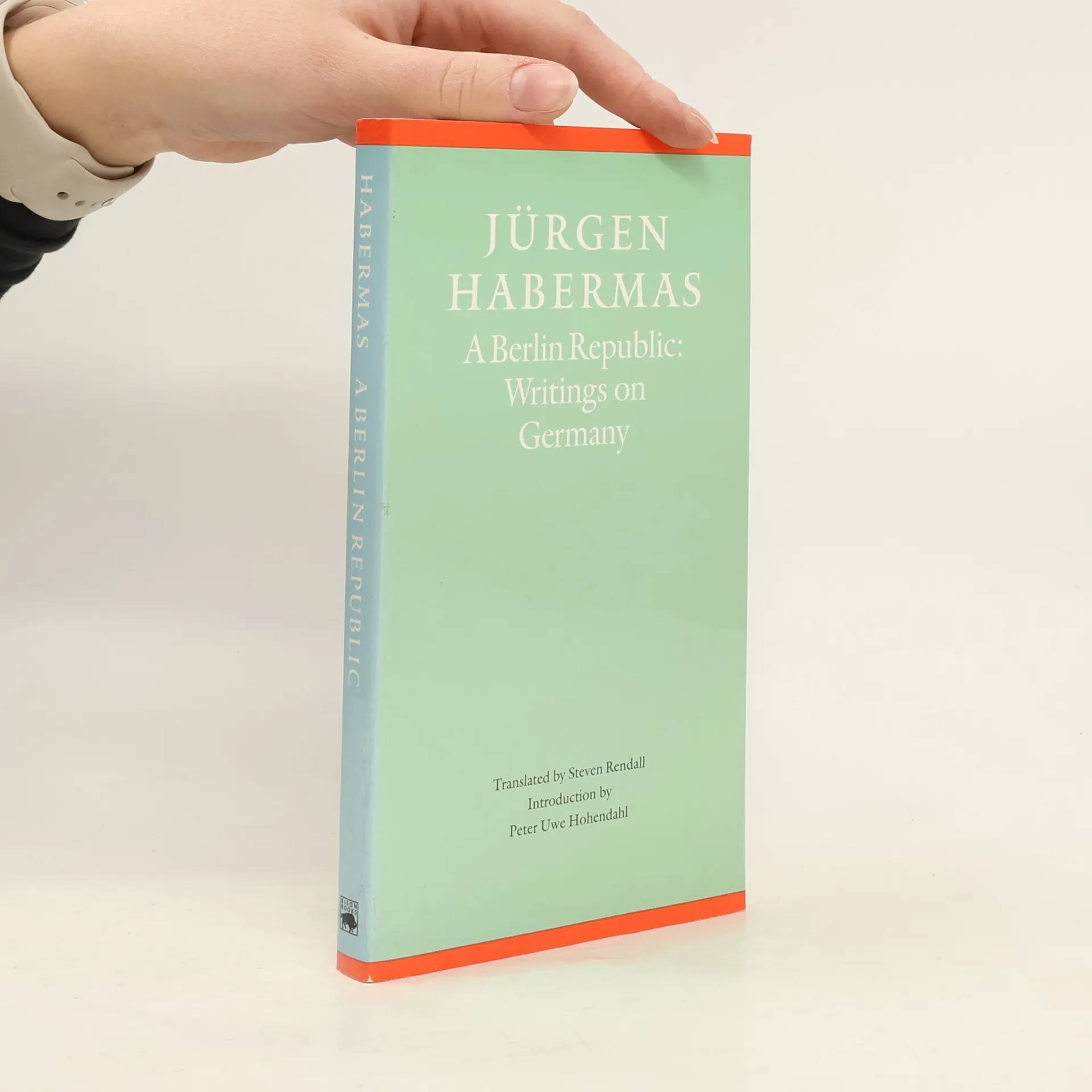
A Berlin Republic, Jürgen Habermas, Peter Uwe Hohendahl, Steven Rendall
- Jazyk

- Rok vydania
- 1997
- product-detail.submit-box.info.binding
- (mäkká)
Platobné metódy
Tu nám chýba tvoja recenzia
- Titul
- A Berlin Republic
- Podtitul
- Writings on Germany
- Jazyk
- anglicky
- Vydavateľ
- University of Nebraska Press
- Rok vydania
- 1997
- Väzba
- mäkká
- Počet strán
- 190
- ISBN10
- 0803273061
- ISBN13
- 9780803273061
- Série
- Pôvodný názov
- Die Normalität einer Berliner Republik
- Hodnotenie
- 3,55 z 5
- Anotácia
- A Berlin Republic (Die Normalität einer Berliner Republik) brings together writings on the new, united Germany by one of that country’s most original and trenchant commentators, Jürgen Habermas. Among other topics, Habermas addresses the consequences of German history, the challenges and perils of the post-Wall era, and Germany’s place in contemporary Europe. Here, as in his earlier Past as Future, Habermas emerges as an inspired analyst of contemporary German political and intellectual life. He repeatedly criticizes recent efforts by historians and political commentators to “normalize” and, in part, to understate the horrors of modern German history. He insists that 1945—not 1989—was the crucial turning point in German history, since it was then that West Germany decisively repudiated certain aspects of its cultural and political past (nationalism and anti-Semitism in particular) and turned toward Western traditions of democracy, free and open discussion, and respect for the civil rights of all individuals. Similarly, Habermas deplores the renewal of nationalist sentiment in Germany and throughout Europe. Drawing upon his vast historical knowledge and contemporary insight, Habermas argues for heightened emphasis on trans-European and global democratic institutions—institutions far better suited to meet the challenges (and dangers) of the next century.